Blog / Personal Injury

How Can an Accident Lawyer Assist With Insurance Claims?

Having an accident lawyer on your side can make a big difference when you're trying to bring an insurance claim. While many people think that an accident lawyer in New York is really only someone you need if you're filing a lawsuit, a skilled attorney can do a lot more than just represent you in court.

Understanding Your Rights and Options

If you hope to get all the compensation you're entitled to under New York law, you need to know what rights you have and all your options for obtaining compensation. Because of New York's no fault rules in car accidents, in a lot of cases, you will be making a claim against your own insurance company. However, there are cases where you can make claims against the other driver's insurance for various things.

If you've had property damage, you may be able to make a claim to cover things like your deductible and out-of-pocket expenses that you have as you get your car fixed, even if the primary cost of fixing the car comes from your own insurance policy. If you are injured so badly that it qualifies as a serious injury under New York law, you can bring a lawsuit. Additionally, even if you or another driver primarily caused the accident, if there was a third party not a driver who bears some blame, this may provide another avenue for compensation. Essentially, you don't know what all your rights and options are until you talk with a qualified lawyer.

Gathering and Preserving Evidence

For you to get all the compensation that you need after an accident, you have to bring solid evidence before the insurance company. If they deny your claim, good evidence allows you to fight the denial effectively. As a lay person, you may not know all the evidence you need and where to find it. Your lawyer will, and your lawyer will also know how to document and preserve it properly.

Negotiating with Insurance Companies

Even when you are making a claim against your own insurance company, your goals and theirs are fundamentally at odds. As a business, an insurance company needs to bring in more money than it lets out, which gives them an incentive to minimize their payouts.

Insurance companies are notorious for using legal jargon, complicated technicalities, and delay tactics to deny valid claims or pay out less than requested. It's even not unheard of for an insurance company to have an unspoken internal policy to always deny a claim the first time, forcing customers automatically to challenge the claim to get what their policies clearly award them. Lawyers understand all the tactics that insurance adjusters can use and how to counter them.

Calculating the Full Extent of Damages

It's not always straightforward to calculate the full extent of the damages you're owed. It's easy to concentrate just on the big items, like your medical bills and the cost of replacing a car, but your lawyer will help you think about other things, like ongoing medical treatment and possible rehabilitation, lost opportunities for overtime or promotion, and other possibilities.

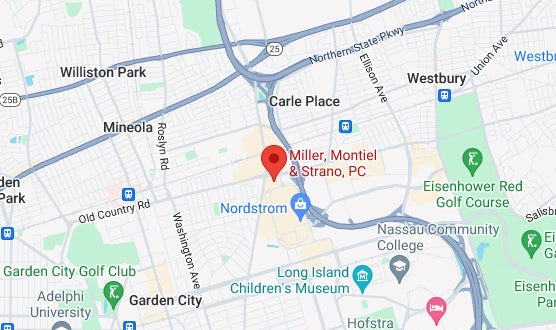
For expert assistance with your insurance claims, contact Miller, Montiel & Strano, PC, in Garden City, NY today for help anywhere in the city or in Nassau County. 
Posted in:

Related Posts

5 Most Dangerous Intersections in Long Island for Car and Pedestrian Accidents

Car crashes, truck collisions, and pedestrian accidents are all too common on Long Island—and certain intersections pose a greater danger than others. A Newsday investigation identified key hotspots in Nassau and Suffolk Counties where fatal and serious injury collisions occur more frequently than anywhere else. Whether you’re driving, walking, or biking, knowing which intersections to avoid can help reduce your risk of being injured in a crash. At Miller, Montiel & Strano, we’ve represented countless victims injured at these very locations, and we’re here to help you understand where the risks are—and what your legal options may be. Top 5 Most Dangerous Intersections in Nassau and Suffolk Counties 1. Old Country Road and Broadway – Hicksville This intersection sees a high number of pedestrian accidents. The multi-lane crossing exposes walkers to high-speed traffic for longer durations. Drivers often race through yellow lights, increasing the danger for pedestrians. 2. Jackson Street and North Franklin Street – Hempstead Ranking second in pedestrian crashes, this intersection—along with the nearby crossing at North Franklin and Front Street—has become a hotspot for pedestrian injuries. Poor visibility and traffic congestion play a major role. 3. Straight Path and Sunrise Highway – Lindenhurst This intersection recorded the highest number of people killed or seriously injured in a 10-year study. The mix of high speeds, left-turns, and frequent U-turns creates a dangerous environment for everyone on the road. 4. Old Nichols Road and Veterans Memorial Highway – Islandia The Central Islip Fire Department responds to 30 to 50 accidents a year at this site. The area’s layout, heavy truck traffic, and lack of driver awareness all contribute to frequent collisions. 5. Route 347 and Nicolls Road – Centereach / Lake Grove / Stony Brook This busy intersection is known for multi-vehicle crashes, often involving trucks. Its size, complexity, and heavy volume make it especially risky. Why Are These Long Island Intersections So Dangerous? Several common factors make these intersections more hazardous than others: Multiple Lanes & Long Crosswalks: Longer exposure time for pedestrians. High Traffic Volume: More vehicles lead to more opportunities for conflict. Frequent Turning Vehicles: Left turns and U-turns often result in collisions. Speeding & Aggressive Driving: Drivers rushing through intersections contribute to more severe accidents. Distracted Driving: Cell phone use and lack of attention are major issues on Long Island roadways. How to Protect Yourself Whether you’re driving or walking, use extra caution at these intersections: Pedestrians: Use crosswalks, obey signals, and make eye contact with drivers. Drivers: Yield to pedestrians, avoid distractions, and never rush yellow lights. Cyclists: Wear visible clothing and follow the same rules of the road as motor vehicles. Injured in a Crash at a Dangerous Long Island Intersection? If you or a loved one was injured at one of these or any other intersections on Long Island, the attorneys at Miller, Montiel & Strano can help. We’ve recovered compensation for clients injured in car, truck, pedestrian, and bicycle accidents throughout Nassau and Suffolk Counties. You may be entitled to compensation for: Medical expenses Lost income Pain and suffering Permanent disability Property damage Don’t try to navigate insurance companies or legal claims alone. Our legal team is ready to stand by your side, investigate your case, and pursue full and fair compensation on your behalf. Contact Miller, Montiel & Strano Today for a Free Consultation We understand the toll an accident can take. If you’ve been hurt at a dangerous intersection in Long Island, call Miller, Montiel & Strano today for a free, no-obligation consultation. We’re here to help you move forward. Call 516-363-5003 or visit https://www.mmspersonalinjurylawyers.com/ Frequently Asked Questions Q: What should I do after an accident at a Long Island intersection? A: Call 911 if you’re injured, seek medical care, take photos of the scene if possible, and contact an experienced car accident attorney like Miller, Montiel & Strano to protect your legal rights. Q: Who is liable in an intersection accident? A: Liability may fall on a negligent driver, a government entity responsible for poor road design, or even multiple parties. We conduct a thorough investigation to determine fault. Q: How long do I have to file a claim in New York? Time periods depend on the type of claim and the parties involved. Therefore, it is best to contact a car accident attorney like MMSPC as soon as possible after the crash.

Manhattan Parking Garage Collapse Highlights Dangers of Negligent Building Design and Maintenance

Manhattan Building Collapse Linked to Faulty Design and Poor Maintenance, Investigation Finds In 2023, tragedy struck in Lower Manhattan when a multi-level parking garage collapsed, killing one person and injuring five others. In the aftermath of the disaster, the City of New York commissioned a forensic engineering investigation to determine what went wrong. The findings are deeply concerning. According to the investigation, the collapse was the result of two major factors: improper building design and ongoing poor maintenance. Shockingly, reports also indicate that unauthorized construction was taking place inside the garage at the time of the collapse — without any permits or safety oversight. Six workers were inside the building when it gave way. All six were injured; one of them tragically died as a result of his injuries. The lives of these individuals and their families were forever altered — not by an unforeseeable accident, but by what appears to be preventable negligence. Negligence in Building Ownership and Maintenance Property owners in New York — and everywhere — have a legal duty to maintain their buildings in a reasonably safe condition. When they fail to meet this duty, and someone is hurt or killed as a result, the law may consider it negligence. Unfortunately, the Manhattan parking garage collapse is just one of many examples where this duty has been ignored. Common causes of preventable building accidents include: Faulty or unsafe structural design Use of cheap, low-quality materials Poor or rushed construction practices Failure to inspect or repair known hazards Inadequate responses to tenant or worker safety complaints Unauthorized or unpermitted renovations General lack of upkeep and neglect over time When these issues are ignored, the results can be catastrophic — including collapsing ceilings, breaking staircases, cracked and lifted sidewalks, falling facades, and structural fires. These are not just violations of safety codes; they are direct threats to human life. Holding Negligent Property Owners Accountable At Miller, Montiel & Strano, P.C., we have extensive experience representing victims of premises liability and building safety failures. We understand the complex nature of these cases, the building codes that apply, and the forensic investigations required to prove liability. Most importantly, we fight to hold negligent parties accountable and help our clients recover the compensation they deserve for medical expenses, lost wages, and pain and suffering. If you or someone you love has been injured due to a building collapse, unsafe property conditions, or any form of property owner negligence, you may have the right to file a personal injury claim. Our team will evaluate your case and explain your legal options — with no obligation and no upfront cost. Contact Miller, Montiel & Strano, P.C. today for a free consultation. Your rights matter — and we're here to protect them.

How Can You Prove Negligence in a Personal Injury Case?

If you have been injured in an accident that was someone else's fault, you may be able to claim compensation for your injuries. The key is proving that the other person was negligent. A New York personal injury lawyer explains what is needed. Duty of Care To prove negligence, you first must show that the defendant had a “duty of care” toward you. This means someone's legal duty to act with reasonable care to prevent harm to someone else. A duty of care is based on the relationship between the parties or the circumstances involved. more For example, a driver is assumed to have a duty of care to everyone else on the road simply by being behind the wheel of a vehicle. The owner of a business has a duty of care to customers and therefore is responsible to make sure their premises are free of hazards. Breach of Duty You must then establish that the duty of care was breached. You must prove that the other person failed to meet their duty, either through their action or their failure to act. Breach of duty is usually measured against what “a reasonable person” would do under similar circumstances. For example, a driver who is distracted or driving recklessly has breached their duty of care to others on the road or to their passengers. A medical professional who failed to follow professional standards would also be considered to have breached their duty of care. Causation It is not enough to prove a duty of care and a breach of that duty. You must then show that the other person's failure directly caused your injuries, property damage, or other losses. You must show that the harm wouldn't have occurred without the other person's negligence. Causation generally falls into two types: cause-in-fact and proximate cause. For cause-in-fact, you must show that the other person's actions were a factual cause of the injury, such as a driver running a red light and hitting a pedestrian. Proximate cause means that the injury was the foreseeable result of the failure in duty. For example, premises that were improperly maintained and led to a slip-and-fall accident. Damages The final element of negligence is actual evidence of the damages caused. Damages encompass both economic and non-economic losses due to the accident. Economic damages include any tangible loss that can be quantified financially, with evidence such as medical bills, bills for repair or replacement of property, and proof of lost wages. Non-economic losses cover those intangible losses you have suffered as a result of the incident. This could include pain and suffering or emotional distress, among others. Evidence from therapists, or even your own personal diaries may help to prove non-economic damages. If you have been injured in an accident caused by someone's negligence, reach out to Miller, Montiel & Strano in Garden City, NY.